It took roughly 530 years from Gutenberg's press in 1440 to the first digitization efforts in the 1970s, to write and print an estimated 130+ million book titles, scaling from a handful of skilled printers to an industrial workforce as mechanization took hold. Digitizing a meaningful share of that archive then took just 30 to 45 years, as scanning technology and projects like Google Books converted tens of millions of titles with teams a fraction the size of the print era's workforce.
From there, the leap into AI training happened in just 5 to 10 years (almost instantly by comparison), with pipelines like Common Crawl and Books3 feeding a substantial share of that same digitized corpus directly into machine learning models.
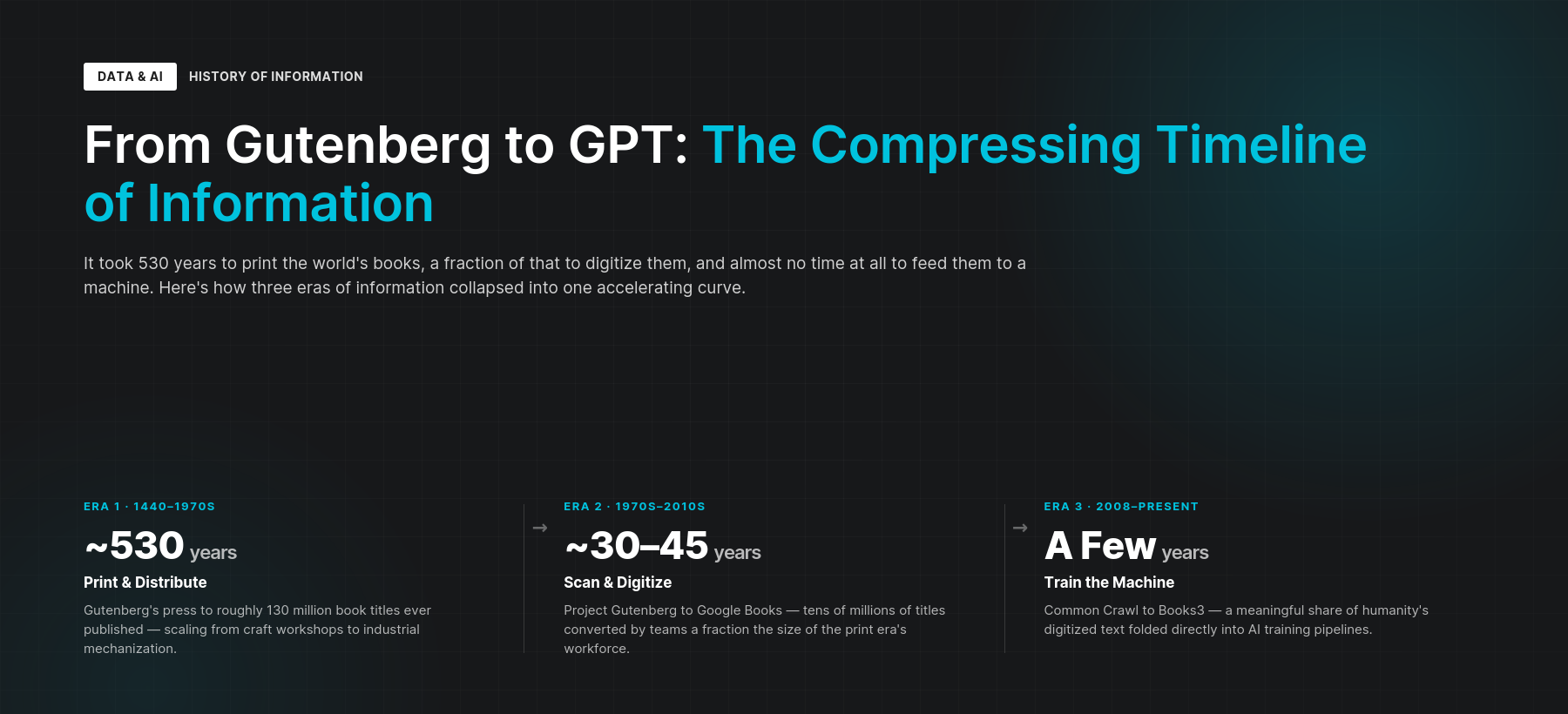
Five centuries to create it. A few decades to digitize it. A handful of years to feed it to a machine. That compression is the real story behind every AI initiative today and it's worth flagging, because it means the quality of your AI outcomes was decided before any model touched your data. Whatever your technology is supposed to do, it's only as good as the information feeding it. That's not a caveat. It's the whole game.
The data problem hiding behind the AI problem.
Most mid-size firms don't have a technology problem so much as a foundation problem. Data lives scattered across siloed systems with no unified way to access it. There's no single source of truth when the same customer, order, or transaction shows up differently across three different applications. Structured and unstructured data sit side by side with no classification or governance distinguishing one from the other, and nobody can point to a data inventory or lineage map that shows where any of it actually came from.
None of this is unusual. But it's expensive. Fragmented data slows integration timelines, breaks consistent reporting, and quietly starves the business functions that depend on trustworthy information to serve customers well. And here's the part that catches people off guard: none of it gets fixed by adding more technology on top. More tools pointed at ungoverned data just produces ungoverned data faster.
AI didn't create this problem. It just elevated the stakes.
Decisions built on ordinary systems and dashboards used to carry a certain baseline of trust that was flawed, maybe, but familiar. Once AI enters the picture, that trust gets harder to hold onto, even when nothing about the underlying data actually changed. People start treating every AI-generated output with suspicion, regardless of whether the data behind it was solid or shaky to begin with. That instinct isn't irrational. But it does mean the cost of having messy data has quietly gone up. The same gaps that were merely inconvenient before are now the difference between an AI initiative people trust and one they quietly work around.
Getting to clarity, before anything else gets built.
Our approach to modern data management starts with two things, in this order, before a new tool or system gets discussed.
First, we find out what you have. A structured discovery process catalogues every data source across your internal applications, system feeds, and outside integrations (who owns it, how good it is, and where it came from). Most firms are surprised by what turns up once this baseline exists.
Second, we find out what it needs to do. Through a handful of focused sessions with the people who use it, we prioritize the business use cases that matter most, then check them against what the data can currently support. This surfaces gaps worth closing and the opportunities worth building toward, by domain: sales, finance, operations, wherever the need is most critical.
What clarity actually looks like.
Done well, this work ends with something simple: one place where your data can live, is structured and governed well enough that every team and every application can draw from the same trustworthy source instead of reconciling five different versions of the truth. We've seen this play out directly. In one recent engagement, this kind of foundational work turned scattered receivables and payment data into a single real-time source feeding an entire lending platform, cutting what used to be a manual, error-prone process down to something that could integrate in weeks instead of months. That's what a real data foundation makes possible. Not just cleaner reporting but new things becoming buildable that weren't before.
If your organization is facing its next data challenge, the clarity conversation is worth having first. Reach out to Navor Consulting to talk about getting started.

AI Changed the Tools. It Didn't Change the Stakes.

The Offset of Innovation