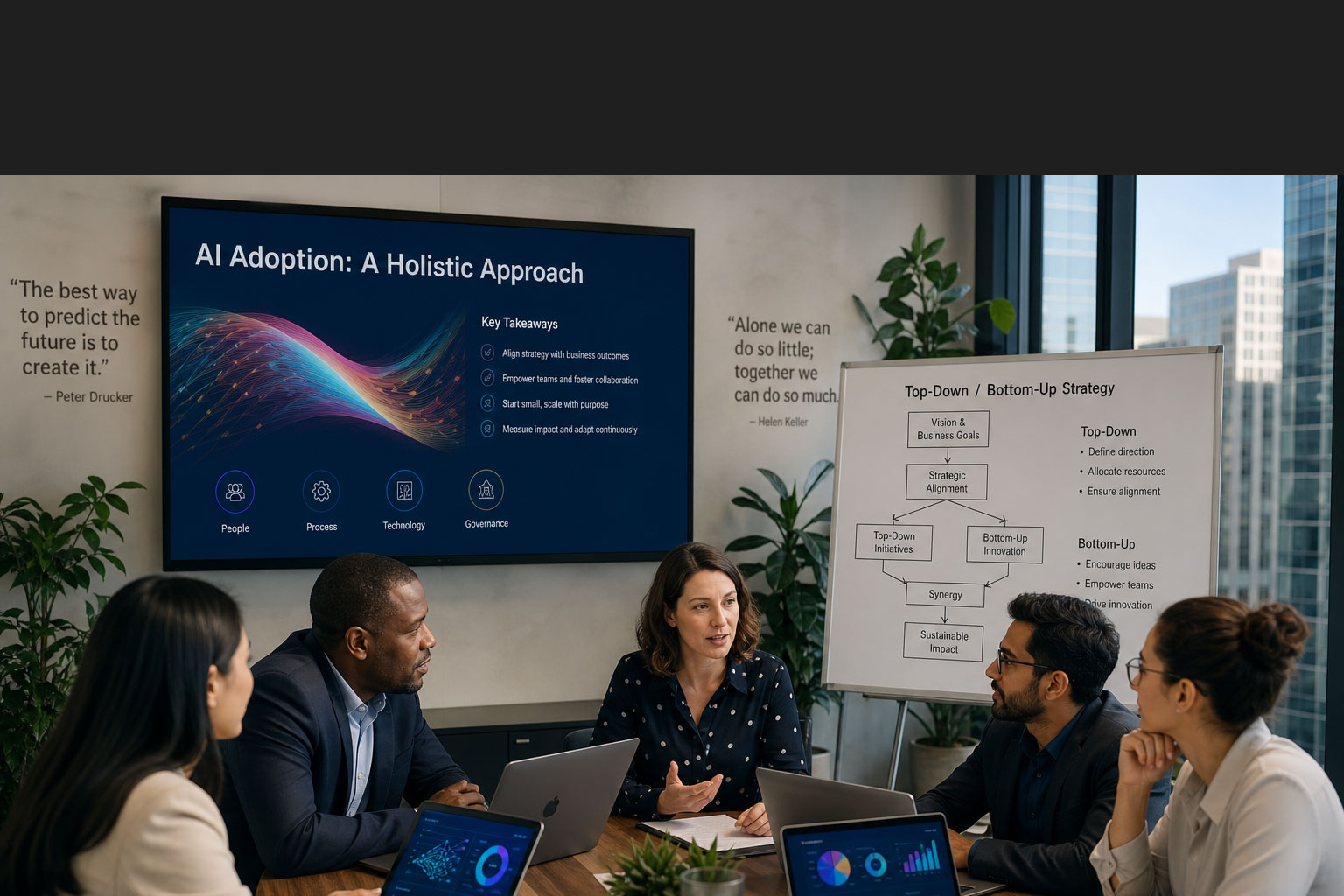
AI can reach into nearly every corner of your business. It can automate a process, streamline day-to-day efficiency, reshape a core operating system, or change how one person handles their individual responsibilities. That range is exactly what makes AI adoption hard to plan for.
The real question
The question isn’t whether AI belongs in your organization. It’s where, and at what level. Which opportunities deserve an organizational standard? Which belong to a single department? And which are simply part of doing an individual job better?
Answering that question well is what separates a scattered AI rollout from one that moves the business forward. A Top-Down/Bottom-Up approach gives you a way to sort opportunities by the level at which they need to be managed, so you invest formality where it’s earned and speed where it’s safe.
Both halves of the approach share one starting point: clarity before technology. Before you commit to building anything, top-down or bottom-up, take the time to understand what that specific opportunity needs to succeed. Skip that step and you end up either over-engineering something small or under-governing something that matters company-wide.
Top-down: make the right bet
Top-down opportunities are the ones with reach. They touch multiple core functions, tie directly to this year’s key initiatives or KPIs, and carry a heightened need for a consistent standard across every team involved.
Because of that reach, these opportunities need to be evaluated, defined, and developed like the business systems they are. That means clear ownership, a defined path to standardization, real governance, and a plan for how the solution evolves after launch. It also means being willing to say no. Not every opportunity that looks big deserves the investment, and part of clarity before technology is deciding which few bets are worth making at all.
AI has given us the ability to evaluate and build faster than ever. That speed is real, but it doesn’t remove the need for discipline. A solution with organization-wide impact still deserves the rigor of a proper business system, no matter how fast the technology lets you move.
Bottom-up: think whole-system
Bottom-up opportunities are smaller by design. They live inside a single department, or inside one person’s job. The right response here isn’t a formal system. It’s giving your people a solid set of tools, setting clear standards for how those tools get used, and training your teams to see how their own work connects to everything around it, not just their corner of it.
This approach matters for a reason beyond efficiency. Without it, employees will find their own AI tools and use them their own way, often without anyone realizing what data is being shared or where. A clear toolset and training program closes that gap. It manages the risk of shadow AI while giving employees real ownership over improving their own work, with an understanding of how that work fits the whole business.
Why you need both
Top-down solutions carry the promise of a large return from a single investment. Bottom-up solutions aim smaller, improving one workflow or one role at a time. But add up enough of those smaller wins across every department and every job, and the combined return can exceed what any single top-down solution delivers on its own.
Neither approach replaces the other. Top-down opportunities protect the initiatives that matter most to your organization’s performance. Bottom-up opportunities build a culture where your people are equipped, trained, and trusted to improve their own work continuously.
The common thread
Whether an opportunity is top-down or bottom-up, the same discipline applies. Both require clarity before technology and a planned approach to implementation, one that accounts for adoption, risk mitigation, scalability, and impact. Skip that planning at either level, and you either build a fragile system or open the door to uncontrolled risk.
Getting this right means prioritizing your resources on the opportunities that move the business forward, while building the foundation for your people, your most valuable resource, to keep growing alongside the technology.
If you’re trying to figure out where your organization’s AI opportunities fall, and how to sequence them, that’s a conversation worth having early. Reach out to Navor Consulting to talk through where your business stands today.